


From Personal Theory to General Theory: The Scholarly Journey
We are all theorists. We may not recognise ourselves as one, but we continuously develop explanations of how things work, why people behave in particular ways, and what makes certain outcomes more likely than others. We have a personal theory of every phenomenon that we observe around us.
An experienced manager knows when to approach a difficult stakeholder, how to motivate a team, or why a seemingly promising strategy might fail. These are not random instincts. They are explanations developed through observation, experience, reflection, and repeated action. In other words, they are personal theories.
But how do these personal explanations become knowledge that others can benefit from? This is where the scholarly journey begins.
Three Levels of Theory
We can understand theory through three interconnected levels: Personal, Collective, and General.
1. Personal Theory: What I Believe and Understand
Personal theory develops through our individual experiences. It is shaped by what we have observed, encountered, interpreted, and learned over time.
Consider a senior professional who believes that organisational transformation succeeds only when middle management genuinely supports it. This belief may have emerged from leading several transformation initiatives and observing how managerial resistance or support influences outcomes.
The professional acts on this understanding, refines it through experience, and gradually develops confidence in the explanation.
Personal theories are valuable. They are the foundation of professional expertise. However, they also have limitations. They are often implicit, shaped by individual contexts, and rarely examined systematically. What appears true in one organisation may not necessarily hold in another.
The first step, therefore, is to make our personal theories explicit: articulate what we believe, why we believe it, and what experiences have shaped our understanding.
2. Collective Theory: What We Believe Together
Our personal understanding does not develop in isolation. We work in organisations, industries, and professional communities where people develop shared explanations of how things work.
These constitute collective theories.
For instance, an organisation may collectively believe that employee attrition is primarily driven by compensation. This belief influences its HR policies, retention strategies, and managerial decisions. It may be based on years of organisational experience, but that does not automatically make it a complete or accurate explanation.
Collective theories are embedded in organisational culture, professional conventions, accepted practices, and shared assumptions. They often go unquestioned because they have been reinforced over time.
This is where an interesting opportunity emerges for a practitioner-scholar. Does your personal understanding agree with the collective explanation? Does it challenge it? Are there gaps between what people collectively believe and what actually happens?
Examining these differences can reveal interesting research possibilities.
3. General Theory: What We Can Explain Beyond Our Context
General theory takes understanding to another level. It seeks to explain a phenomenon through systematic inquiry, evidence, and rigorous examination.
Unlike personal theories, it is not restricted to an individual’s experience. Unlike collective theories, it is not simply an accepted belief within a particular organisation or professional community.
General theory offers explanations that others can examine, question, apply, and build upon in different contexts, subject to the conditions and boundaries within which the explanations hold.
Consider Everett Rogers’ Diffusion of Innovations theory. Developed through systematic research, it explains patterns in how innovations spread across populations. Its insights have informed thinking in areas as diverse as technology adoption, marketing, agriculture, and public health.
This is the power of general theory: knowledge developed through inquiry in particular settings becomes useful to people dealing with similar phenomena elsewhere.
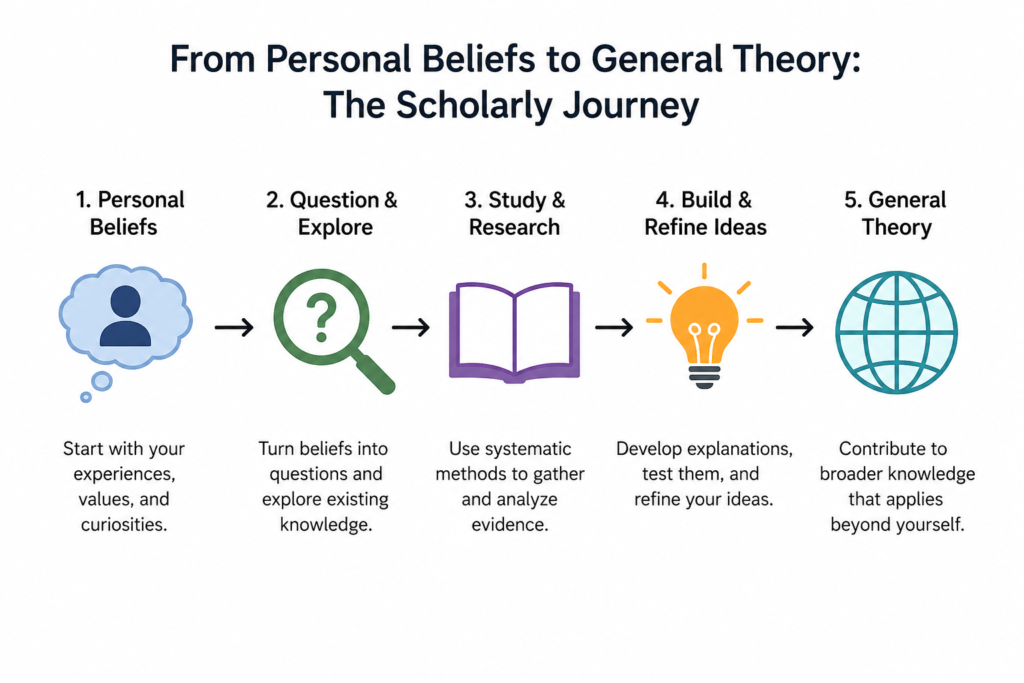
The Scholarly Journey: Moving from Personal to General
Your doctoral journey is not about abandoning your professional experience and starting afresh with academic literature. It is about taking what you already know and developing it further.
You begin with a phenomenon that intrigues you and your personal explanation of it. You then examine how your organisation, industry, or professional community understands the same phenomenon. Finally, you engage with existing academic theories and research to discover what is already known, what remains unexplained, and where your investigation might contribute.
The differences, contradictions, and gaps between these levels can help you formulate a meaningful research question.
Through systematic research, you examine your assumptions, gather evidence, engage with alternative explanations, and develop insights that extend beyond your immediate experience.
Not every doctoral study produces a new general theory, nor does every contribution require one. But every serious scholarly inquiry has the opportunity to improve, refine, challenge, or extend existing understanding.
Remember: You are not beginning your scholarly journey without knowledge. You are beginning with knowledge that needs to be articulated, examined, and developed further.
The movement is from what I understand, to what we believe, to what we can explain and share with others.
That is the journey from practitioner to practitioner-scholar. And that is how experience can become a meaningful contribution to knowledge.