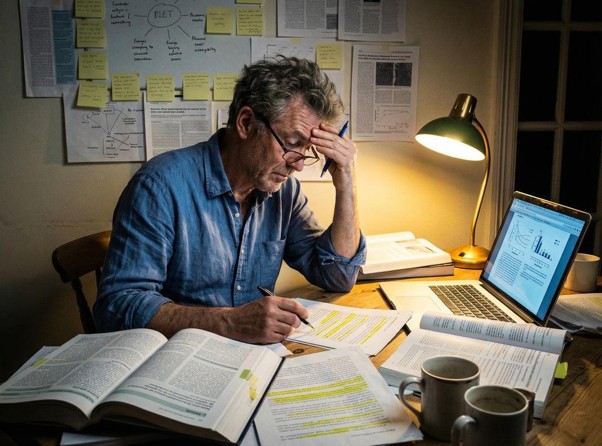
Am I Good Enough to Be a Scholar?
There is a moment in the doctoral journey when an experienced professional begins to question something that once seemed unquestionable: their own capability.
For years, they have made difficult decisions, led teams, solved complex problems, and earned the respect of colleagues. They have learned to trust their judgment. Their professional identity has been built around competence, experience, and the ability to find answers.
Then comes doctoral research.
Suddenly, the familiar sources of confidence begin to lose their strength. The problems are less structured. The answers are rarely definitive. A well-developed argument can be challenged by a supervisor, a research paper, or a methodological concern. An idea that seemed compelling may not withstand academic scrutiny.
And the scholar begins to wonder: Am I good enough?
This question can be particularly unsettling for experienced professionals. They are not accustomed to feeling like beginners. In their professional lives, uncertainty often signals a need for action. In research, uncertainty may be the very condition in which meaningful thinking begins.
The transition is not simply about learning academic methods. It involves reconstructing one’s intellectual identity.
A successful professional may be comfortable saying, “I know how to solve this problem.” A developing scholar must become comfortable saying, “I do not yet understand this phenomenon, and I need to investigate it.”
That difference can feel uncomfortable, even humiliating.
The temptation is to interpret every difficulty as evidence of inadequacy. A supervisor’s critical feedback becomes a judgment of personal ability. A rejected argument becomes proof that one does not belong in academia. A slow chapter becomes a reflection of one’s intelligence.
But research does not work that way.
Intellectual uncertainty is not incompetence. It is often the beginning of deeper understanding. The ability to recognise what one does not know is not a weakness; it is an essential scholarly capability.
You may have spent decades becoming an expert in your professional domain. Doctoral research asks you to enter a different domain, with different expectations, different standards of evidence, and a different relationship with knowledge.
You are not starting from zero. Your experience provides valuable insights, questions, and access to phenomena that others may not recognise. What you are learning is how to transform those insights into a defensible scholarly contribution.
That transformation takes time.
Confidence, therefore, cannot depend on always knowing the answer. It must gradually emerge from the ability to work through uncertainty, accept criticism, revise one’s thinking, and continue despite incomplete understanding.
Perhaps the more useful question is not, “Am I good enough to be a scholar?”
It is this:
“Am I willing to become the scholar I have not yet learned to be?”
You are not stuck because you are incapable. You may simply be learning to operate in a world where uncertainty is not an obstacle to overcome, but a condition of discovery.