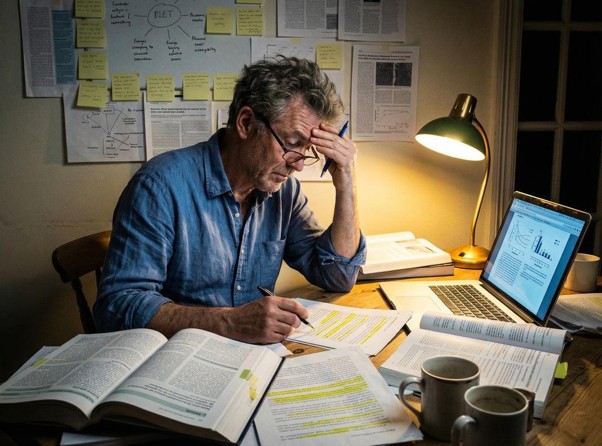
The DBA Scholar’s Impossible Calendar: Work, Family, and Research
There are days when the DBA scholar looks at the calendar and wonders how the doctorate was ever supposed to fit into life.
A demanding professional role. Family responsibilities. Meetings that extend beyond working hours. Children who need attention. Parents who need care. Household obligations that cannot be postponed. And somewhere between all these commitments sits the thesis, waiting for the attention it rarely receives.
The calendar is full. The mind is exhausted. Research remains unfinished.
For many working professionals, pursuing a doctorate is not simply a matter of managing time. It is a matter of negotiating competing responsibilities, each of which carries its own expectations and emotional weight.
At work, the scholar is expected to deliver. At home, the scholar is expected to be present. In the doctoral programme, the scholar is expected to read, analyse, write, and make meaningful progress.
And the scholar is expected to do all of this without allowing any responsibility to suffer.
The result is often a persistent sense of guilt.
When research receives attention, family may feel neglected. When family takes priority, the thesis does not move. When professional obligations consume the week, the scholar promises to write over the weekend. When the weekend arrives, exhaustion takes over.
Even rest begins to feel like a failure.
The guilt of not writing can become particularly difficult. A scholar may spend an entire day fulfilling professional and family responsibilities, yet go to bed feeling that the day was wasted because no academic work was completed.
But was it really wasted?
The doctoral journey exists within a life that has other legitimate demands. Professional commitments are not distractions from life. Family responsibilities are not obstacles to scholarship. They are part of the reality within which the research must be pursued.
The challenge, therefore, is not to create a perfect calendar. It is to develop a sustainable relationship with research.
This may mean accepting that progress will not always be continuous. Some weeks will produce substantial writing. Others may offer only a few hours of reading or a brief reflection on an emerging idea. There may be periods when professional or personal circumstances temporarily take precedence.
Interrupted progress is not necessarily abandoned progress.
A useful shift is to stop measuring doctoral commitment exclusively through hours spent writing. Research also advances when a scholar clarifies a question, identifies a conceptual gap, revisits an assumption, or develops a better understanding of the phenomenon being investigated.
Small, deliberate steps can sustain intellectual engagement even when extended periods of uninterrupted work are unavailable.
Equally important is learning to distinguish between genuine neglect and reasonable prioritisation. Not every evening must be devoted to the thesis. Not every family occasion must be sacrificed for academic progress. Not every delayed chapter signals a lack of commitment.
A doctorate is a significant undertaking, but it should not require the complete suspension of life.
Perhaps the most important question is not how to fit more into an already impossible calendar.
It is how to pursue meaningful research without continuously feeling that one is failing at everything else.
The DBA journey is not a race between work, family, and research. It is an attempt to bring these different parts of life into a workable relationship.
And sometimes, the most productive decision a scholar can make is to close the laptop, spend time with family, and return to the research tomorrow without guilt.
Because the goal is not merely to finish a thesis.
It is to become a scholar while continuing to live a meaningful life.